
Understanding tenant premiums and fees
When a tenant applies for a PandaGuarantee, we quote them a premium — the price they pay for the guarantee that protects you. This article explains how that price is set, why it varies from…
On this page
Understanding tenant premiums and fees
When a tenant applies for a PandaGuarantee, we quote them a premium — the price they pay for the guarantee that protects you. This article explains how that price is set, why it varies from tenant to tenant, and why it can't be adjusted after the fact.
How the premium is calculated
Every premium comes from a single internal pricing formula. It looks at the tenant's financial profile, the amount of coverage you've required, and a set of indicators that predict the likelihood of default. The main inputs are:
- Credit profile. The tenant's credit score sets the base rate.
- Income relative to rent. We compare the tenant's combined household income to the monthly rent to assign a risk tier.
- Amount of coverage. The premium is charged against the total rent we're guaranteeing — the monthly rent multiplied by the number of months covered.
- PandaDeposit. Tenants who also use PandaDeposit in place of a cash security deposit.
- Payment schedule. Tenants who pay the full premium upfront receive a discount compared to paying monthly.
- Renewal. Tenants renewing an existing guarantee receive a 15% renewal discount.
Why we can't adjust a quoted price
The formula is applied the same way to every applicant, and the price it produces is the lowest price we are able to charge for that tenant and that coverage. We don't negotiate premiums, offer case-by-case exceptions, or adjust a price on request from either the tenant or the landlord.
A quote will change only if one of two things happens:
- 1The information the tenant provided turns out to be incorrect (for example, a different income or credit result than stated), or
- 2The coverage requirements change — such as a different rent amount, number of months, or portion of rent covered.
In either case, the tenant is re-quoted using the same formula with the correct data.
Example
Here's how the inputs come together for a real application we received, renting at $2,000 per month with 12 months of coverage:
Combined household income: $60,000Credit score: 600Base rate: 10.6%Risk tier: Low Rent guaranteed: $24,000 (12 × $2,000)Partial coverage: Full Upfront payment: YesRenewal: No
Annual premium: $1,378
Had this tenant paid monthly instead of upfront, or had a lower credit score, the premium would be higher. Had they renewed for a second year, the 15% renewal discount would apply.
What this means for you
You don't pay the premium — the tenant does — and the price they're quoted has no effect on the coverage you receive. If a tenant tells you their quote is too high, the only things that can change it are correcting their application information or adjusting the coverage you require.
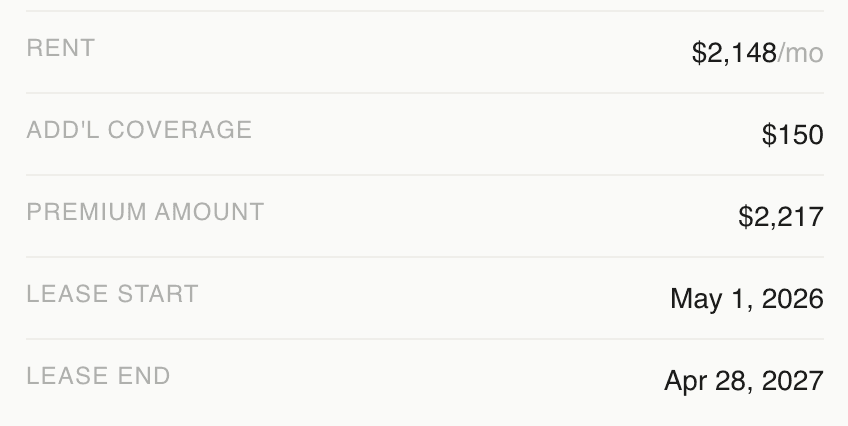
You can see the exact quote a tenant received by viewing the "Premium Amount" on the applications page of your landlord dashboard.
Didn't find what you needed?
Ask our team